Saturday, 2 April 2011

GeeknRolla 2011


This Wednesday saw around 500 people descend on the Park Plaza Victoria for GeekNRolla 2011, Mike Butcher’s annual startup conference. Priced at £150 it’s significantly cheaper than most of the well known US conferences (or indeed Le Web), although it is on a smaller scale.

The event attracted some great speakers, including prolific angel investor Dave McClure giving his usual profanity riddled Startup Metrics for Pirates talk, Morten Lund delivering his unique brand of slightly unhinged inspirational advice and some great insights from Martin Varsavsky founder of FON.

Wendy Tan White took us through the rollercoaster ups and downs of running Moonfruit from 1999 to the present day, and a fireside chat (sans fireside) with Josh Williams of Gowalla revealed plans to open a London Gowalla office.

As usual with these events, you have to make a tradeoff between the panels/talks/pitches and talking to people in the lobbies and corridoors. I tried to see most of the speeches and pitches but skipped some of the panels.

Show me the money
In a surprise turn of events, DFJ Esprit decided to offer the winner of the pitching competition a £50k investment in the form of a convertible note priced on par with the next investment round. For those not familiar with venture finance, this is a pretty good offer, since it effectively means that DFJ are not being compensated for the early stage risk compared to a later stage investor - typically convertibles are priced at a discount to the next round.

It’s worth noting that taking seed capital from a VC does carry some signalling risk if they don’t follow on, and convertible notes have the disadvantage of giving the investor and the founders differing incentives for the pricing of the next round. However given DFJ’s reputation and partner Nic Brisbourne’s active involvement in the London startup community, I can’t imagine anyone turning down the offer.

Startups Pitching
I thought it would be interesting to take a look at the companies that were pitching. Each was given two minutes to pitch and then had a few questions from the judging panel:

Duedil (overall winner).  Aggregating business information. A bit like CapitalIQ, but with the intention of providing end users access to company data for free. In their pitch they had a great example use case for consumers - verifying the credentials of a visa service before handing over your passport. Beyond this one can easily see many uses - small businesses running checks on customer or partners, competitive intelligence, investor research etc.

In the presentation they mentioned “Business Voyeurism”, and after playing around with the rather slick alpha-release product today, I can see exactly what they mean - it’s pretty addictive to just navigate around the details of companies and directors with such ease. Of course this data is all already publicly available from the likes of Companies House at low, but non-zero, cost through a slightly clunky interface, and so it’s the ease of use combined with zero cost and aggregation of multiple data sources that makes Duedil such a great product. The UI could still do with some tweaks, but it’s looking pretty good and I can see why they deserved to win the competition.

During the presentation they struggled to explain a concrete plan for monetization, and from speaking to them afterwards I think in part this stems from their strong drive for using Duedil as a tool to encourage transparency and hence always keep the basic product free to use. I’ve no doubt they’ll solve the monetization question in due course.

WireWax. Making video clickable. These guys have built an application that allows you to highlight hotspots in videos (like people or objects). The application will then track them through the video and allow end users to click on the tagged areas or hover over them for information. This can then be used to e.g. find out what clothes people are wearing and then click through to buy them. The product seemed to be fairly well developed and they already had ITV as a customer.  A pretty good presentation and the questions from the panel seemed to focus on the fact that there were several competitors in this space.

ArtSpotter. Crowdsourced Art finding maps. An iphone app at the moment, presuamably with plans to move to other platforms if they get traction. Most impressive thing about this which the panel didn’t pick up on was that the founder got the app built for just £1500 (and didn’t develop it herself).

Frameblast (Clearer Partners). This one appeared to be a B2B marketplace for video production services. I say appeared to be since I’m not sure I fully understood the pitch. I suspect the presenter may have suffered a little from being deprived of the notes accompanying his slides.  They seemed to have assembled a team with strong industry knowledge (ex-BBC and Joost), so I guess they know what they’re doing. Perhaps a case of the shoemaker's children going unshod? With a bit more polish I’m sure with their production background they can deliver a much better pitch.

PoraOra. Browser based 3D learning. Kids wander through a virtual world (MMORPG style) except instead of slaying each other or building virtual property empires, they solve sums and practice their spelling.

The graphics looked pretty slick and they had a nice marketing video which seemed to work well. PoraOra uses a virtual pet as the incentive mechansim - learn your times tables the pet gets healthier, mess up your negative numbers and Fido is off to the glue factory. The virtual pets following the kids around reminded me a little of the daemons in Phillip Pullman’s His Dark Materials, but I guess this game is aimed at a younger audience.

Education is a topic close to my heart, and Khan Academy has demonstrated the kinds of innovation that are now possible in the way we teach and learn, in particular giving learners control over their learning, and giving teachers/parents access to much more data and analytics than has ever been possible before.

The main concern raised by the panel was the question of how effective the game would be in keeping the attention of ADHD riddled kids. That’s a tough one to crack, but I guess there’s no reason why kids can’t play both PoraOra and Grand Theft Auto rather than picking one over the other.

TheSocialCV.com. Collects social information about people, runs some semantic analysis and compiles it into a unified profile. They mentioned it was in a similar space to the Salesforce acquired Jigsaw, and it also sounded similar to Qwerly (although it sounds like they do more semantic processing). Started as a research project with Google. From the name and the site, it appears the main focus is on using the application for recruiters.

Online social identity certainly seems to be an attractive market, which also means there are quite a few people competing in a similar space.

The biggest issue with the pitch seemed to be that they were pitching a product rather than a business but paradoxically they didn't really get to the product until about half way through the pitch. The demo when they showed it look pretty good, and would have been better to have this up front. They used a recorded demo from SXSW, but it would have been amazing if they could have run a demo based on the people currently at GeekNRolla.

Yearbook Machine. An yearbook creation service with a focus high quality design and good UX. Having been part of the team putting together a yearbook at grad school, I’m very familiar with the pains involved, and I can see the economics of this business making sense (spreading fixed costs over many customers etc).

Most of the panel’s questions were about competitors and the risks of general album/photobook printing services (like Blurb) moving into the yearbook space. However I suspect that if these guys have a slick product focussed on the Yearbook vertical, they should be fine and could possibly exit to one of the album publishers.

The presenter wore a yellow pocket square which was a nice touch. Not because the sartorial standards at GeekNRolla were lacking, but rather because little quirks like that make sure people remember you, and make you easy to find for anyone who has questions. Startup t-shirts work fine too in case you’re a bit rusty on pocket square folding techniques.

AreaNow. A mobile local nightlife app. Very offbeat presentation style and slides. There are quite a few people trying to solve the local events problem - maybe this team might manage to do it but it’s not immediately obvious how.

Qublus. Indoor positioning based on radio signals. Didn’t go into details about their technology, but said it works better than GPS or Wifi triangulation indoors. You need to map the building before you can use it, but then the end users just require a mobile app on their phone. They've built a mall app in Sweeden already. Certainly intruiging - if the technology is as good as claimed this could have a number of applications, including delivery of hyperlocal advertising in places like Westfield.

FlyPost. Turning distressed events into deals (e.g. groupon for unsold local ticket inventory).  Simple and to the point presentation. Bringing effective yield management to local businesses is something that GroupOn defintely have in their sights, and there are several people competing in the ticketing space, however nobody really seems to have cracked this one yet, so plenty of opportunity.

One issue raised by the panel is the problem of adverse selection - the only tickets sold on this service will be undesirable ones that haven’t already sold. While this is certainly true, there’s a certain underlying assumption in the question that all tickets have the same utility for all customers, which isn't true. Thus just because most people don’t want to go see Justin Bieber in concert next Saturday in Slough, doesn’t mean other people wouldn't were they made aware of the opportunity at a low enough price.

MarketInvoice. Pitched as working capital financing for SMEs, but essentially a marketplace for factoring invoices. From the questions and answers it seems that they take care of grouping together the debts in tranches and also syndicating them amongst investors. Not sure where the responsibility for assessing the credit risk lies, but seems like a classic internet disintermediation play like Zopa. The main question seems to be whether there are enough businesses interested in joining as factors.

Art finder. An art discovery and sharing site. They also produce a collection of ipad apps in the style of coffee table books along with print on demand artwork. A new take on presenting art - seemed to be well put together and I guess the only questions are really around who else is competing in the same space. If Artfinder can build a strong database of art and form partnerships with museums and artists, then they should be in a pretty good position.

Updates and a tip for future
There were also updates from BraveNewTalent, Conversocial, GroupSpaces and Qwerly who all seem to be making great progress one year on from the last GeeknRolla. Special mention has to go to Max Neiderdoerfer for the most hilarious (yet informative) presentation featuring the Rageguy.

All in all a great conference, and a great place to launch a startup. The one thing I’d recommend to anyone pitching is to make sure you’re early on in the running. By the time the later pitches occurred the room was more than half empty, and in particular the last few were in the dreaded just-before-lunch slot. Might be worth re-arranging the pitches to put half in the afternoon instead to make it a little fairer.

Sunday, 27 February 2011

Product Camp London


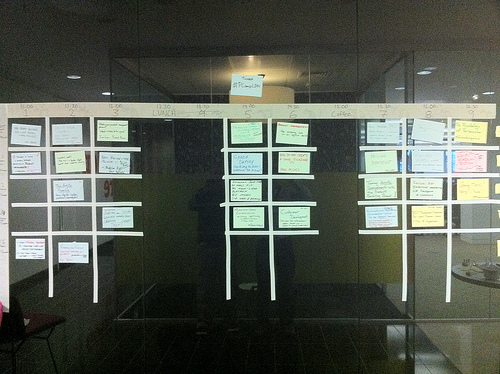
I spent most of yesterday at Product Camp London, hosted at the expectedly trendy offices of The Guardian. Product Camp is an unconference focussing on product management and marketing. For those not familiar with the format, an unconference is a participant-generated conference where those attending the conference sign up to give the talks. These can be organised in various ways, but Product Camp took a simple approach with a blank timetable on the wall with around 4 streams and 9 timeslots where people stuck post-it notes with sessions they wanted to run.

http://www.flickr.com/photos/simoncast/5481722709/


The product focus is predominantly on software and web based products (at least nobody I spoke to was building a dual cyclone vacuum cleaner in their shed), and the skew seemed to tend towards the startup end of the market rather than more established companies.

It's great to see these kind of community organised events in London, and judging by the adhoc job-board which sprung up, there's strong demand for good product people which is hopefully a good indicator of tech company growth.


I only arrived halfway through the event, so unfortunately missed the morning sessions, but to give you a flavour of the talks, the ones I attended were

  • Software tools and multi-sided markets. This one turned out not really to be about multi-sided markets at all, but was an interesting discussion on marketing products where the end user and buyer may be different people (as is the case in many enterprise sales)
  • Customer Development. A quick overview of the classic Steve Blank startup philosophy given by Salim Virani of Lean Camp fame along with some group discussion about how it could it be applied in practice.
  • Product Pricing. A talk by Paul Lomax of Dennis Publishing  looking at ways in which pricing tactics like decoy prices and bundling can change consumer buying behaviour. Had there been more time it would have been useful to take a quick look at some of the underlying mirco-economic principles like consumer surplus and price discrimination, but it was a good talk with some great input from the audience. This one ended up winning the prize for the best session of the day.
  • Social Advertising. A look into how to advertise on social networks along with discussion about what does and doesn't work. The good thing about this one was that it discussed real numbers for CTRs, CPCs etc. (this one was given by my brother so I may be biased...)
  • Psychology of Persuasion. Covering the basics of various persuasive techniques that can be used in marketing products (reciprocity, social proof etc). Some overlap with the pricing talk, but I guess that can't be avoided in an unconference.

As with most of these events, many of the interesting discussions happened outside the main sessions, in the coffee breaks, lunch and the Google-sponsored drinks afterwards. The format worked well, and hosting it on a Saturday ensured a certain level of self-selection regarding interest in product management and marketing.

Overall a great event and a great job by the organizers in pulling this together.

Friday, 14 January 2011

Coadec Panel - Government and the Digital Economy


On Wednesday night Techhub hosted a panel discussion organised by Coadec on government and the digital economy. No doubt the video will be up somewhere soon enough, but in the meantime here's a quick summary with some thoughts.

Big Apple, Big Smoke, Big Taxes
Several perennial issues came up such as taxation and shortages of skilled labour. More interestingly, the debate moved from the endlessly rehashed Europe vs The Valley to London vs New York, which is a much more useful comparison.  Looking at the east coast of the US we can probably pick up a few tips on how startups and tech firms can compete for labour with the finance sector. On the subject of New York, Sean Senton-Rogers of PROfounders Capital noted that once you take into account all the relevant taxes, startups actually pay more tax in New York than London. Similarly it was mentioned that Dublin's low corporate tax doesn't really make much difference to startups (and presumably is done to favour larger companies who are considering expanding to Europe).

Too busy to care about government
On the topic of the hastily enacted digital economy bill, Wendy Tan of Moonfruit highlighted that most startups are so focussed on minding the shop (quite sensibly) that they don't have time to consider government policy making. This is a particular problem when their interests may not be aligned with those with more lobbying firepower. Tory MP David Davis suggested that this doesn't mean that startups should get together to hire expensive lobbyists, but rather that they need to become more effective communicators. I'd be curious to see how this is handled in the US - can early stage startups abdicate this responsibility to VCs and grown-up startups like Google? Sean suggested that individual VC firms could do more, rather than relying on the BVCA, although one would assume government lobbying is one of the main reasons for the BVCA's existence.

The opposite of Dr Beeching
Regarding the thorny topic of net neutrality, David Davis made the observation that were we to have huge oversupply of broadband, we could make it a moot point. A few tweeters wondered how this could be reconciled with small government, but I'm not sure this is a huge issue. There's a big difference between governmental nudges to push infrastructure in the right direction and wholesale nationalisation as suggested by someone in the audience. If the marginal cost of increased bandwidth is relatively low, then this doesn't seem like a bad idea, although it carries the risk of the overcapacity being rendered obsolete by new innovations.

Politics 101
It was good to see two MPs that seemed to have a decent handle on tech affairs, and they made the point that if you want politicians to educate themselves on an issue, then the best way to do that is to make it an election issue. This presumably is the House of Commons equivalent of the classic schoolboy "Sir, will this be on the exam?"

Focus, Daniel-San
Overall a worthwhile way to spend a few hours, with a good turnout. The panel was probably a little too large to allow for proper discussion, but I'd be hard pushed to say who should have been dropped. Perhaps an event more focussed on a single issue might be an option for any future sessions.

Wednesday, 5 January 2011

Government and Startups: Financing


How can the UK government help with startup financing?

London co-working space Techhub recently hosted an event featuring a Q&A with government minister David Willets on the topic of how the government can help the local tech startup community. Several interesting points were raised, but the two main issues seemed to revolve around finance and labour. In this post I’m going to focus on startup finance and I'll do another one later with thoughts on labour issues.

All businesses need capital in order to function - both seed capital to get going, and further capital to grow. Broadly, this capital can take three forms, and the government can assist with all three.

1. Debt Financing
There was some discussion during the event about how banks weren't lending to startups. It’s important to understand that banks aren't generally in the business of risky financing (relative to equity). Banks will only lend where there is reasonable expectation that the borrower will be able to meet the repayments schedule. This normally means either stable cashflows or reliable outstanding receivables. They will often want personal guarantees or collateral. 

The Silicon Valley Bank coming to London is good news - they’re a bank which knows how to deal with startups, and will no doubt make life a bit easier as well as encouraging other banks to up their game. But ultimately they are a bank with exactly the same fiduciary duties as any other bank - they're not going to be handing out credit like candy.

Debt financing may also come in the form of loans from friends and family. I'm not sure structuring this kind of financing as debt is a particularly great idea since most likely they’re taking on quite a lot of risk for limited upside, and so it's a better deal to offer them equity. However some might prefer the simplicity of a loan. 

How the goverment can help: In truth I think there’s not a lot the government can (or should) do to interfere with bank lending procedures. Schemes like the Enterprise Finance Guarantee are a useful short term measure for a tight economic climate, but will only help those on the margins of lending decisions. 

2. Equity financing
For the vast majority of startups, equity financing is the most important source of capital. Equity investors will usually specialize by sector and investment stage depending on the level of risk they are willing to take. Early stage investment will usually always be riskier than later stage.

Equity finance might come from individuals (business angels, friends etc) or from institutions such as VC funds.

How the goverment can help: As with debt finance, it's not the government's job to change investment criteria or decide which individual businesses should get investment. However there are at least two ways the government can increase the total quantity of equity capital available for early stage ventures -

a.) Capital Gains Tax. The presence of taxation skews the risk-reward curve, since it affects the ultimate cash return from the investment. By reducing capital gains tax investors get higher returns for the same level of risk.


b.) Increasing the supply of capital directly. The best way to do this is to invest alongside outside investors with an existing fund manager. This is exactly what ECFs are designed to do. It would be great to see some top tier VCs participating in this program. David Willets promised to come back for a second session with somebody involved with the ECFs in January, so keep an eye out for this. In particular it will be interesting to see what the minimum investment amounts are for these funds and how they can balance that with attracting the best fund managers.

3. Internal Financing
Finally, the best kind of financing is from customers (i.e. from revenues). Typically most startups will not be able to make enough from this source to fund high speed growth, but we shouldn't ignore this as an source of finance.

How the government can help: Buying from startups. This includes making startups aware of opportunities to bid for government work, and also the “competition prize” model for innovative solutions as with the Technology Strategy Board.

Should the government help with startup finance?
We've addressed some of the things the government could do to assist startups. Whether they should do these things or not is more difficult question. Some will carry a financial cost (like reducing CGT), which may not lead to an immediately measurable return. Every pound spent in this way is a pound that could be spent on more established industries, the NHS, education etc and is ultimately a policy decision for the government. 

In addition to the usual government capital allocation problem, any situation in which a the government is directly injecting cash into startups risks crowding out private investment and ultimately weakening the ecosystem. This kind of intervention only makes sense where there is market failure, and it's not immediately clear that this is the case. 


Saturday, 1 January 2011

Charity begins at Startup

http://dilbert.com/strips/comic/1996-01-16/

I usually like to get some reading done over the holiday season. In truth this means I order a stack of books from Amazon and then maybe get through a small fraction. This year, top of the reading pile was Behind the Cloud by Marc Benioff, recounting the early days of CRM startup Salesforce.com.

It's a worthwhile read if you look past the occasional veneer of self-promotion, and one of the things that caught my attention was the chapter on corporate philanthropy. Charitable giving by corporations can be a tricky topic; while the end goals are usually very worthwhile, it can be hard to avoid the image of a company reaching into shareholder pockets to donate money on their behalf. 

In general, corporate giving (in cash or kind), like any corporate spending, should only be done where it results in a return greater than could be achieved by a shareholder donating the money themselves. There are many cases where this is true and results in value creation. 

The problem with corporate social responsibility programmes is that they can often seem like a bolt-on or afterthought on the part of the company. Salesforce took an interesting approach by insisting that giving back to the community be embedded in the DNA of the company from the outset. In particular, Marc Benioff and his co-founders created a charitable foundation at the same time as incorporating their company, and donated 1% of their equity to the foundation.

I love the simplicity of this idea - it requires no cash outflow and ensures that the foundation's endowment grows alongside the company. 

I'm not necessarily suggesting that all startups follow the foundation-on-foundation idea. In most cases it's probably not worth the paperwork until you're making real money. But it would be a simple thing for startup founders to agree in principle to set aside a small chunk of equity for for a foundation, much as they would with an employee option pool. Alongside agreeing to set aside this equity, it would be prudent for the founders to decide on the guiding goals of the foundation.

In addition to the initial 1% equity, Salesforce also donates 1% of employee time and 1% of profits (in the form of software discounts to charities). They also took the quite unusual step of moving all their education and large NGO customers to the foundation, providing the foundation with a sustainable income stream. 

A big advantage of baking corporate philanthropy into the core of a startup from day one is that all employees and investors know what they're getting into up front. Is this likely to put off some investors? Possibly. But as long as appropriate safeguards are in place (regarding rules on profitability), it may even attract investors that are better aligned with your own goals.


Thursday, 9 December 2010

Proxies for Happiness


There’s been a lot of talk recently from the government about measuring happiness to use it as a metric of success. Now perhaps the ultimate aim of all governments ought to be to increase happiness, but given that it’s such a hard thing to measure objectively, most settle for some economic measure (GDP or GDP per capita) as a proxy.

This raises many questions about whether GDP is a good proxy for happiness (for one it ignores income disparity), and whether some alternative measure would be better suited, say by conducting some kind of happiness survey. Rather than answering this thorny question, I want to take a look at a somewhat simpler problem - measuring career satisfaction for new graduates.

Earlier this year whilst doing some research for a potential new startup, I spent some time looking at university careers services. These are the departments within universities that are responsible for helping students find jobs once they graduate. These departments all seem to be driven by one key statistic - the number of graduates in employment 6 months after graduation (of those looking for employment, so excluding those pursuing postgraduate study etc). This is often published in prospectuses and university websites as a means of attracting students, and presumably is also used internally to measure the success of the careers departments. The use of this statistic is also reinforced by the Higher Education Statistics Authority (HESA) which conducts an annual survey on the destination of graduates 6 months after graduation.

Now this certainly isn’t a bad statistic to measure, and combined with the salary distribution information most careers departments also publish, it should give any potential students a fair idea of what to expect from a given university. What these statistics completely fail to measure is whether these students have ended up in jobs they are happy with. You could argue that in the current economic climate, students might well be happy to have any job, but in the longer term its probably better for both employers and employees if they’re not tied together solely by economic necessity.

So this takes us right back to the problem of measuring happiness. Except that in the case of jobs there’s a very simple proxy for happiness. Namely, the length of time a person stays with their employer. Or to make it a bit easier to digest, the percentage of people that remain in their job 2 years after graduation (or whatever time interval you choose). There’s an assumption here that the majority of people who leave their jobs do so because they’re unhappy (for whatever reason), which seems reasonable. Maybe they’re unhappy with pay, progression, location, flexibility, hours etc - but clearly something makes them move on. It’s possible that they might not have left of their own volition, but again it seems reasonable to assume that redundant or fired employees aren’t filled with joy at their situation. The time interval needs to be reasonably short since we’re effectively also assuming that happiness when they leave is representative of the whole period of employment, which won’t be true for longer periods (e.g. somebody who leaves after 5 years may well have been very happy for 3 years).

There’s obviously a cost associated with universities tracking this kind of data as it would require them to contact all their alumni two years after graduation (though doing this online would reduce costs). However, given the increasing squeeze on funds at universities, might it not be prudent to stay in regular touch with alumni as possible future benefactors? Using a hapiness metric would incentivise career services to place students in jobs that they’re likely to be happy in, and it wouldn’t surprise me if they find happy alumni are more inclined to reach for their chequebooks when the alma mater comes a-calling.

Monday, 22 November 2010

Techcrunch Europas 2010

What was good
Techcrunch Europe’s annual awards evening, The Europas, took place last Friday. Around 300 people gathered at Paramount, on top of the Centre Point tower. As promised, the views were indeed spectacular, and the turnout seemed to attract a good mixture of people from across the tech startup scene.

Image: Sarah Rowlands/Miller Hare

In particular it was great to be reminded of the great startups that are right on our doorstep like Moshi Monsters (someone mentioned 1 in 3 kids in the UK are users), Flattr, Tradeshift, Whipcar, Wonga, Spotify, and many others, check the TC article for the full list. Nice to see startup friendly law firm Winston and Strawn getting recognition for their great efforts.

It was interesting to hear founder Tariq Krim talk about the newly released Jolicloud notebook given that I'm in the market for a netbook at the moment. Not sure I'll be rushing out to buy the Jolibook just yet, but might be interesting to install Jolicloud as a second OS for dual boot on whichever netbook I do end up getting.

I was quite impressed to see that the toilets (well the gents at least) were covered with guerilla marketing stickers from the various startups in attendance keen to use every opportunity to get free publicity. Perhaps not too surprising given the crowd...

Awards ceremony or party?
Although the event was a great opportunity  for the community to recognize successes, I do wonder whether the format could be improved upon a little. There seemed to be a two-fold purpose to the event, as an awards ceremony and also as an end-of-year party. That’s absolutely fine of course, except the two seemed to be happening simultaneously, with people talking over the announcements and awards. Not really the fault of the attendees, since the long thin shape of the venue meant that a lot of people were quite removed from the stage in the middle of the room.

The awards part also seemed very rushed, almost in a “lets get this out of the way so we can get on with the party”, with award winners asked not to give speeches as they rolled through the award conveyor belt. The main issue I have with this approach is that in any given month (even week) there are usually plenty of parties/networking events/meetups going on in London which provide plenty of opportunity for people to socialise over drinks. But the Europa awards are a bit more distinct - they only happen once a year, so why not put the focus on them and make it more of an awards show, followed by a party, Academy Awards style?

That way we could have a seated venue, which would encourage people to pay attention to the presentations. We could have speeches from the winners - it would be great to hear what these people have to say and any wisdom they have to impart, as well as offering them a platform to ask for anything they need (money, employees etc). I realise this means the presentations part would run a lot longer, but given that the event was on a Friday night and started pretty early, there’s not really a big shortage of time. Have an intermission or two to allow people to eat/move around in the middle if necessary.

Finally, I must admit there were several startups mentioned that I’d not heard of before - a short video clip/pitch of the winners (or maybe top nominees + winners) would be a great way of educating the audience and getting some free publicity.

Of course it’s very easy to say all this as an attendee, and this shouldn’t take away from the fact that it was an entertaining evening which obviously had a lot of hard work and preparation go in to it. Mike opened the proceedings by saying how fed up he was of the constant comparisons to the US and the Valley in particular, but in truth if we want to build an ecosystem for tech entrepreneurship in this country, and Europe more generally, then these kinds of events are important in raising awareness of all the great work going on around us.

See you all there next year!